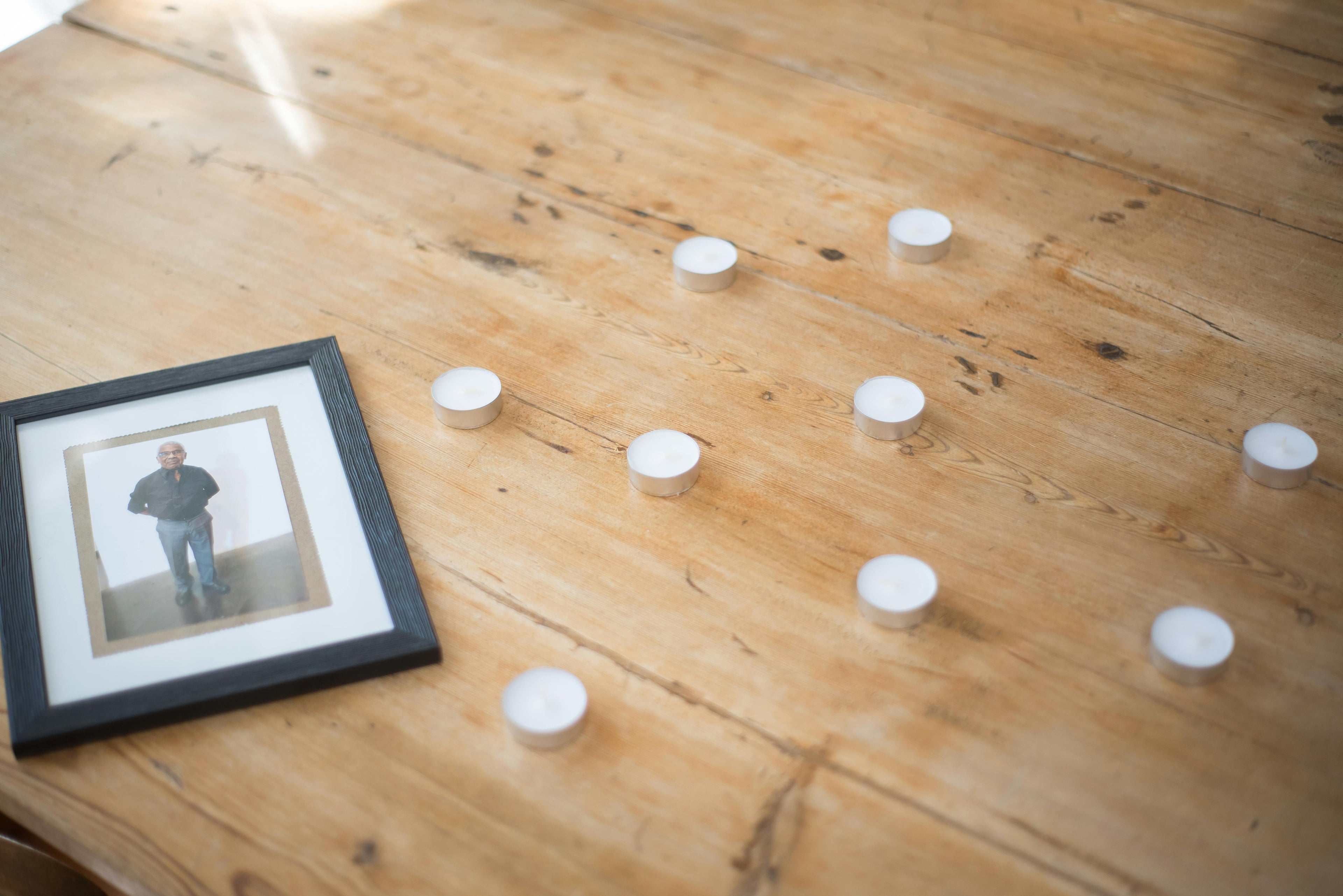

If you've ever typed "personalized remembrance candle" into a search bar, there's a decent chance you weren't shopping the way you'd shop for a coffee table or a pair of boots. You were looking for a thing you didn't quite have a name for — something physical, something specific to a person yo u've lost, something to do with a feeling that doesn't have anywhere obvious to go.
This is a guide to that thing. What a personalized remembrance candle actually is, how it's different from a "sympathy candle" or a generic memorial candle, why grief researchers think this kind of small ritual helps, and how to choose one if you decide it's worth trying.
If you already know you want one, you can shop the Afterlight personalized remembrance candle collection → — hand-poured in the USA, customizable with a name, dates, or your own short message.
What a personalized remembrance candle is
Strip away the marketing language and a personalized remembrance candle is three things layered into one object:
- A candle — usually hand-poured soy or coconut wax, in a glass vessel, with a clean burn time of roughly 40 to 60 hours.
- Personalized for a specific person — a name, sometimes a set of dates, sometimes a short message ("I miss you, Dad"), printed on a label or engraved on the glass.
- Built around the act of being lit — designed to be relit on birthdays, anniversaries, holidays, and quiet nights, for years.
It is not a scented candle. It is not home decor. It is not a one-time sympathy product that gets used at the funeral and forgotten. It is a small physical tool that exists for one job: giving the act of missing someone a place to live in your house.
The phrase Afterlight uses internally for this category is "emotional utility product" — a thing you use when you feel something, the way you'd use a coffee maker when you want coffee.
How it's different from a sympathy candle
A sympathy candle is part of the funeral-week sympathy economy. It's a gift sent in the first 14 days after a death, usually with a generic message like "in loving memory." It's meant to be used briefly and then fade out.
A personalized remembrance candle is built to outlast the sympathy wave by years. It's named for the specific person. It's designed to be lit on the dates that matter — birthdays, anniversaries, Mother's Day, Father's Day — and on unscheduled hard nights for the rest of someone's life. It's remembrance, not sympathy.
Why a small ritual like this actually helps
It would be reasonable to be skeptical here. A candle. For grief. The honest answer is that it isn't the wax doing the work. It's the ritual — and the research on grief rituals is more interesting than most people realize.
Continuing bonds, not "letting go"
For most of the 20th century, the dominant model of grief in the West was about "stages" and "letting go." In the 1990s, a group of grief researchers led by Dennis Klass, Phyllis Silverman, and Steven Nickman published Continuing Bonds and reframed the entire field. Their argument, supported by extensive cross-cultural research, was that healthy grief almost never looks like disconnection. It looks like the form of the relationship changing — from a person you talk to in the world to a presence you carry inside. The bond doesn't end. It moves.
A personalized remembrance candle is, fundamentally, a tool for continuing bonds. Lighting it is the physical action of saying I still have a relationship with this person, and I'm not pretending I don't.
Rituals organize what otherwise floods
Grief, untreated and unstructured, behaves like floodwater. Anthropologists have documented for over a century that nearly every human culture creates rituals around death — and those rituals share the same basic structure: a defined moment, a physical action, a focus on the person's name and memory, and a clear ending. The structure isn't decoration. It's containment.
Action versus passivity
Grief is overwhelming partly because it's passive. The simplest psychological gift a grieving person can give themselves is an action they can take. Striking a match is that action. It costs almost nothing. It only takes seconds. And it moves you from the passive end of grief to the active end.
The lit and unlit duality
Afterlight builds its candles around a particular framing: the candle has two states, both meaningful. When lit, it represents missing the person. When unlit, it represents healing. Not forgetting — healing. Most of life with grief is unlit. The hard moments are the lit ones. The candle holds both without asking you to choose.
Who uses personalized remembrance candles
- Adult children of deceased parents — especially adults 30–60 who lost a mom or dad.
- Long-term grievers — 5, 10, or 20 years out, who never built a ritual.
- People grieving a partner, a sibling, a grandparent, or a close friend.
- Parents who lost a child — including infant loss, miscarriage, stillbirth.
- People grieving a pet — especially the loss of a long-time companion dog or cat.
- Gift-buyers sending candles to people they care about.
There is no "right" loss for a personalized remembrance candle. If you loved them, the candle is for you.
What "personalized" actually means
A name. The most important field. A name on the label is the strongest possible counter-statement to the fear that the person will be forgotten. Use what they were actually called. Dad. Mom. Mama. Pop. Tom. Linda.
Dates. Two dates are common: birth and death. But you can pick one date that matters, or none at all.
A short message. This is optional. The pre-written labels exist for the days when no original poetry is happening: I miss you, Dad. I miss you, Mom.
What to look for when choosing one
- Hand-poured, not mass-produced.
- At least 40 hours of burn time.
- Permanent personalization that holds up across many burn cycles.
- Honest, non-corny phrasing. "I miss you, Dad" reads honest. "Forever in my heart, Daddy" reads like a card aisle.
- Unscented or lightly scented. A remembrance candle is about presence, not perfume.
- Made in the USA if you can.
- Religious or non-religious as needed. Most modern personalized remembrance candles are intentionally non-religious.
Afterlight's personalized remembrance candles → check every box — hand-poured in the USA, customizable with a name and dates, available in unscented or lightly scented soy wax, intentionally non-religious.
How to use one
The short version: light it when you need to, blow it out when you're ready, and let it sit unlit the rest of the time.
- On their birthday. The day used to belong to them.
- On the anniversary of their death.
- On Mother's Day or Father's Day.
- On their favorite holiday.
- On a quiet Tuesday night. When the missing arrives without warning.
- As a daily five-minute pause.
Frequently asked questions
What is a personalized remembrance candle? A hand-poured candle customized for a specific person who has died — usually with their name, dates, and sometimes a short message — designed to be relit on birthdays, anniversaries, and hard days for years.
How is it different from a sympathy candle? A sympathy candle is for the funeral-week sympathy wave and is usually generic. A personalized remembrance candle is named for the specific person and is designed to outlast the sympathy wave by years.
Are remembrance candles religious? Not necessarily. Many modern brands, including Afterlight, are intentionally non-religious.
Will lighting a candle make me sadder? Most grief researchers find the opposite. Suppressing the feeling delays it. The candle is a pause, not a trigger.
How long does a remembrance candle last? A well-made hand-poured 8 oz soy candle has a burn time of 40–60 hours, which is enough for years of occasional use.
Can I get one years after they died? Yes. Late grief is still grief.
A quiet ending
A personalized remembrance candle isn't a gimmick, and it isn't decor, and it isn't a cure. It's a small physical tool for one of the oldest jobs in human life: holding the people we love in a way that lets us keep going. You light it. You sit. You blow it out. You go on with your night.
Shop the Afterlight personalized remembrance candle collection → Hand-poured in the USA. Customize with a name, a date, or a short message — or choose a pre-written label.
Related reading on the Afterlight blog: - Memorial Candles for the Loss of a Father → - Memorial Candles for the Loss of a Mother → - How to Cope With Grief at Home: 7 Small Rituals →